Category: Economy

  • Zero-Based Budgeting (ZBB) in the Indian Economy Upsc

    Introduction:

    Zero-Based Budgeting (ZBB) is a budgeting approach where all expenditures for each new period must be justified from a zero base. Instead of relying on the previous year’s budget as a starting point, every proposed expense needs to be thoroughly evaluated for its necessity and cost-effectiveness. The process involves breaking down activities into “decision packages,” which are then ranked and funded based on their contribution to the organisation’s objectives.

    Implementation in India

    • Early Introduction: ZBB was first experimented with in India in April 1987.
    • Government Mandate: In 1986, the Indian government made it mandatory for all ministries to review their programs and activities and prepare their expenditure estimations based on the ZBB concept.
    • Objective: The primary goal was to link financial resource allocation with strategic targets and to identify and eliminate outdated or low-priority programs.
    • Focus: ZBB in the Indian context emphasises a critical review of existing government programs and projects to allocate funds to high-priority areas by removing obsolete ones and reducing funding for less important items.
    • Annual Re-evaluation: A core principle in India’s adoption is the annual re-evaluation of programs as if they were new initiatives, ensuring funding aligns with current priorities.
    • Cost-Benefit Analysis: Programs are subjected to annual cost-benefit analysis, and those falling below prescribed norms are considered for elimination.

    Examples of Application in the Indian Public Sector:

    While specific, widespread and consistently applied examples across all government sectors might be limited or not always publicly detailed, the principles of ZBB have likely influenced various initiatives. Some areas where its tenets could be applied include:

    • Ministry of Health: Identifying and eliminating redundant health programs to redirect funds to critical healthcare initiatives.
    • Public Sector Enterprises (PSE): Enhancing operational efficiency and financial performance by justifying all expenditures from scratch.
    • Panchayati Raj Institutions: Improving financial discipline, prioritising spending, and aligning budget allocations with rural development objectives.
    • ISRO (Indian Space Research Organisation): Applying ZBB principles to ensure efficient resource allocation in its various projects and centres.

    Advantages for the Indian Economy:

    • Improved Cost Control: Scrutinising all expenses helps identify and eliminate unnecessary spending within government departments and public sector units.
    • Enhanced Efficiency: Encourages a review of how activities are carried out, potentially leading to more efficient processes and resource utilisation.
    • Alignment with Strategic Priorities: Ensures that government spending is directed towards programs and projects that best serve the nation’s developmental goals.
    • Increased Accountability: Requires departments to justify their budget requests, fostering greater responsibility in spending decisions.
    • Better Resource Allocation: Funds are allocated based on current needs and priorities rather than historical spending patterns, allowing for more responsive budgeting.
    • Potential for Savings: By identifying and eliminating redundant or low-priority expenditures, the government can potentially free up resources for more critical areas.

    Challenges in Implementation in India:

    • Time-Consuming and Complex: Thoroughly analysing and justifying every expense can be a lengthy and intricate process, especially for large government bodies.
    • Resource Intensive: Requires significant manpower, time, and expertise for effective implementation.
    • Resistance to Change: Government departments accustomed to traditional budgeting methods may resist the shift to a more demanding ZBB approach.
    • Data Requirements: Accurate and comprehensive data on various programs and activities are essential for effective decision package creation and ranking, which might not always be readily available.
    • Lack of Expertise: Training and developing the necessary skills in financial analysis and strategic thinking for government personnel is crucial.
    • Political and Bureaucratic Inertia: Overcoming established practices and potential resistance from various stakeholders can be a significant hurdle.
    • Difficulty in Ranking Qualitative Aspects: Objectively ranking decision packages for programs with non-quantifiable benefits can be challenging.

    Conclusion:

    Zero-Based Budgeting offers a valuable framework for enhancing efficiency and aligning government spending with national priorities in the Indian economy. While it presents significant advantages in terms of cost control and resource allocation, its successful implementation requires addressing challenges related to time, resources, resistance to change, and data availability. Despite these hurdles, the principles of ZBB can contribute to a more rational and effective use of public funds, ultimately supporting India’s economic development.

  • Best books for economy upsc for prelims

    Book TitleAuthorPurposeWhy It’s Good for UPSC Prelims
    Indian EconomyRamesh SinghComprehensive understanding of Indian economyA thorough coverage of Indian economic policies, reforms, and key concepts; ideal for both beginners and advanced students.Buy on Amazon
    Economic SurveyGovernment of IndiaDetailed insights into India’s economy, policy reforms, and government prioritiesThe Economic Survey is updated annually and provides the most current information on India’s economy. Essential for Mains and Prelims.
    Indian Economy: Performance & PoliciesUma KapilaUnderstanding Indian economic policies and performanceCovers all major aspects of Indian economics, from reforms to policies, making it relevant for both Prelims and Mains.Buy on Amazon
    MacroeconomicsN. Gregory MankiwProvides an in-depth understanding of global and Indian macroeconomic theoriesA textbook widely used by aspirants to grasp essential macroeconomic principles. Great for understanding economic cycles, inflation, and fiscal policies.Buy on Amazon
    Upkar’s Indian EconomyConcise and exam-focused reference materialA simplified version of Ramesh Singh’s Indian Economy, focusing on key facts and concepts, suitable for revision.Buy on Amazon
    Indian EconomySanjiv VermaSimplified and exam-oriented content focused on economicsA focused book on important economic concepts, ideal for last-minute revision before Prelims.Buy on Amazon
    Indian Economy for UPSCNitin SinghaniaQuestion-and-answer based format for UPSC exam prepHelps in quick revisions and practice. Structured to align with UPSC exam patterns.Buy on Amazon

  • Difference between Niti aayog and planning commission

    Difference between Niti aayog and planning commission

    Difference between Niti aayog and the Planning commission

    Niti aayog

    Niti Aayog is the apex public policy think tank of the Government of India. Also, the nodal agency handles the task of accelerating economic development and fostering cooperative federalism.

    This development through fostering cooperative federalism is done with the involvement of the State governments of India in the policy-making process.

    Evolution and Mandate:

    • Established in 2015, replacing the Planning Commission.
    • A think tank offering policy recommendations for national development and economic progress.
    • Focuses on a holistic approach, encompassing economic, social, and environmental aspects.

    Functions:

    • Policy formulation: Provides strategic direction and blueprints for national development plans.
    • Centre-State coordination: Foster’s cooperative federalism, bridges gaps between government levels.
    • Monitoring and evaluation: Tracks progress of implemented policies and identifies areas for improvement.
    • Knowledge hub: Conducts research, analyzes, and disseminates information on critical issues.

    Structure:

    • Chaired by the Prime Minister, with a Vice-Chairperson and CEO leading the execution.
    • Supported by various committees and experts specializing in different sectors.

    Key Reports and Initiatives:

    • Strategy for New India @75: Roadmap for achieving specific development goals by 2022.
    • National Education Policy 2020: Transformational vision for revamping India’s education system.
    • Atmanirbhar Bharat Abhiyan: Fostering self-reliance in key sectors like manufacturing and technology.
    • Sustainable Development Goals (SDGs): Aligning national priorities with global development agenda.

    Planning Commission (India)

    The Planning Commission, though abolished in 2015, remains a significant chapter in India’s economic and political history.

    Origins and Mandate:

    • Established in 1950 under Prime Minister Jawaharlal Nehru.
    • Derived its authority from the Directive Principles of State Policy in the Indian Constitution.
    • A centralized body responsible for guiding India’s economic development through Five-Year Plans.
    • Focused on rapid industrialization, poverty alleviation, and social progress.

    Functions:

    • Formulation of Five-Year Plans: Determined priorities, allocated resources, and set targets for different sectors.
    • Mobilization of resources: Collected data, assessed potential, and facilitated domestic savings and foreign aid.
    • Monitoring and evaluation: Tracked progress of plans, identified bottlenecks, and recommended course corrections.
    • Coordination and collaboration: Worked with central ministries, state governments, and other stakeholders.

    Achievements:

    • Laid the foundation for India’s industrial and agricultural growth.
    • Promoted infrastructure development, including dams, power plants, and transportation networks.
    • Pioneered social welfare programs like the Green Revolution and the Minimum Needs Programme.
    • Played a crucial role in reducing poverty and raising living standards.

    Criticisms:

    • Centralized planning: Accused of being bureaucratic, inflexible, and hindering private sector growth.
    • Corruption and inefficiency: Plagued by allegations of nepotism, favoritism, and misallocation of resources.
    • Focus on top-down approach: Neglected grassroots participation and local needs.
    • Limited success in achieving equitable distribution of benefits.

    Legacy:

    • Though replaced by NITI Aayog, the Planning Commission’s contributions remain undeniable.
    • Its experience and lessons learned continue to guide India’s economic policymaking.

    Historical Context:

    • Newly independent India: In 1950, India stood at a crossroads. Decades of colonial rule had left behind a largely agrarian economy, widespread poverty, and inadequate infrastructure. The newly formed government faced the immense challenge of modernizing and developing the nation.
    • Soviet influence: The prevailing zeitgeist favored centralized planning, inspired by the Soviet model’s rapid industrialization. Jawaharlal Nehru, India’s first Prime Minister, was deeply impressed by this approach and envisioned the Planning Commission as a tool for directed development.
    • Need for a roadmap: Without a clear plan, navigating the complexities of India’s diverse economy and social fabric seemed daunting. The Five-Year Plans, formulated by the Planning Commission, provided a framework for allocating resources, prioritizing sectors, and setting measurable goals.

    Objectives:

    • Rapid industrialization: Building a strong industrial base was seen as essential for generating wealth, creating jobs, and reducing dependence on imports. The Planning Commission prioritized heavy industries like steel, power, and machine tools.
    • Poverty alleviation: Uplifting millions living in abject poverty was a paramount objective. The Planning Commission focused on rural development, agriculture, and social welfare programs like the Minimum Needs Programme.
    • Self-sufficiency: Reducing dependence on foreign aid and achieving self-reliance in critical sectors was a long-term goal. The Planning Commission promoted domestic savings, import substitution, and indigenous technology development.
    • Balanced growth: Ensuring equitable distribution of benefits and development across regions and communities was crucial. The Planning Commission strived to address regional disparities and promote inclusive growth.

    Functions:

    • Formulating Five-Year Plans: This core function involved extensive research, data analysis, and consultations with experts, ministries, and state governments. The plans outlined specific targets for investment, production, and social development in different sectors.
    • Mobilizing resources: The Planning Commission estimated financial requirements, collected domestic savings, and negotiated foreign aid to fund the plans. It also played a crucial role in setting priorities for budget allocation across various ministries.
    • Monitoring and evaluation: Regularly tracking progress against set targets was essential. The Planning Commission conducted mid-term appraisals, analyzed data, and identified bottlenecks or deviations from the plan.
    • Coordination and collaboration: The Planning Commission acted as a bridge between the central government, state governments, and various stakeholders. It facilitated communication, resolved disputes, and ensured coordinated implementation of the plans.
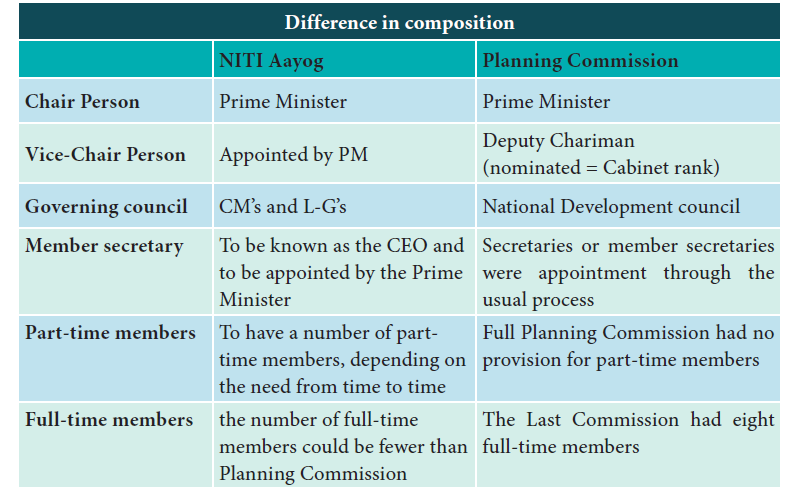
    Niti AayogPlanning Commission
    Chair PersonPrime MinisterPrime Minister
    Vice-Chair PersonAppointed by PMDeputy Chairman(Nominated = Cabinet rank)
    Governing CouncilCM’s and L-G’sNational Development Council
    Member SecretaryTo be known as the CEO and to be appointed by the Prime MinisterSecretaries or member secretaries were appointed through the usual process
    Part-time membersTo have a number of part-time members, depending on the need from time to timeThe full planning commission had no provision for part-time members
    Full-time members the number of full-time members could be fewer than the planning commissionthe last commission had eight full-time members
    Difference between Niti aayog and the Planning commission

    Conclusion

    In summary, while both the Planning Commission and NITI Aayog aim to facilitate economic planning and development in India, NITI Aayog has a more decentralized and flexible approach, encouraging the involvement of states and various stakeholders in the decision-making process. The shift from the Planning Commission to NITI Aayog reflects a change in the philosophy of economic planning in India, moving towards a more inclusive and dynamic model.

  • National Planning Council 1965: A Milestone in India’s Development Journey

    National Planning Council 1965: A Milestone in India’s Development Journey

    Introduction

    The National Planning Council, established in 1965, played a pivotal role in shaping India’s economic and social policies. This council was instrumental in formulating the Fourth Five-Year Plan, which aimed at achieving balanced and rapid development across various sectors. The council’s efforts were crucial in steering the country towards progress and self-reliance.

    Formation and Objectives

    The National Planning Council was set up under the chairmanship of Mr. Ashoka Mehta.Its primary objective was to provide a detailed and thorough examination of key issues related to the main sectors of development. The council was tasked with ensuring that the formulation of the Fourth Five-Year Plan was well-researched and comprehensive.

    Key Achievements

    1. Study Groups: The council established 12 study groups to focus on specific problems in different sectors. These groups included experts from various fields and collaborated with outside consultants to ensure a well-rounded analysis.
    2. Sectoral Focus: The council concentrated on critical areas such as agriculture, industry, education, and health, aiming to address the unique challenges faced by each sector.
    3. Policy Recommendations: The council’s recommendations were instrumental in shaping the policies of the Fourth Five-Year Plan, which emphasized balanced regional development and self-reliance.

    Impact on India’s Development

    The National Planning Council’s work laid the foundation for India’s economic growth and development.. By focusing on sectoral issues and providing well-researched recommendations, the council helped in formulating policies that addressed the country’s needs effectively. The Fourth Five-Year Plan, influenced by the council’s efforts, contributed to the overall progress of India.

    YearEvent
    1965The National Planning Council (NPC) was established in India to serve as an advisory body for development strategies.
    1965-1970NPC actively worked alongside the Planning Commission, providing inputs for India’s Fourth Five-Year Plan.
    1970sNPC expanded its focus to include the participation of industry experts, academics, and policymakers to tackle emerging challenges.
    1980sShifted emphasis toward decentralized planning, aligning with regional and state-specific developmental goals.
    1991The economic reforms era saw NPC advocating for a balanced approach between liberalization and social equity.
    2014NPC’s role diminished after the Planning Commission was replaced by NITI Aayog, which integrated many of NPC’s consultative functions.

    This timeline highlights key phases in the NPC’s journey, from its inception in 1965 to its reduced role post-2014 reforms.

    Conclusion

    The National Planning Council of 1965 was a significant milestone in India’s development journey. Its comprehensive approach to planning and policy formulation set the stage for future economic and social advancements. The council’s legacy continues to be felt in the policies and strategies that drive India’s growth today.

  • Mixed economic system in India Upsc

    Mixed economic system in India Upsc

    Mixed economy in India

    Mixed economy is economy where there is public sector and private sector.

    The idea of a mixed economy was thus adopted which included the liberal policy of encouraging private enterprises and also promoting the public sector for the good of society by socializing the means of production and giving powers to the state to have control over the economy.

    India is an inspiration to many nations for the idea of a mixed economy.

    Article related to Mixed Economy

    Article 38 of the Indian constitution says ‘The State shall strive to promote the welfare of the people by securing and protecting as effectively as it may a social order in which justice, social, economic and political, shall inform all the institutions of the national life.

    The system of a mixed economy works for the realization of this ideal of the constitution. The Industrial Policy Resolution of 1956 was adopted by the Indian Parliament in April 1956.

    It was a guideline for the economic policy of the country. The five-year plans were made on the basis of this resolution.

    It emphasized more powers to the governmental machinery so that a socialistic pattern of society could be realized.

    The industries were divided into three categories:

    • Firstly, there were industries that were entirely state-owned.
    • Secondly, the category of industries which were state-owned but the public enterprises could also be included
    • Thirdly industries which were with the private sector.

    The state had control over all the industries and the third category of industries could not function only for self-interest or profit motives but be regulated for the interest of the entire society.

    The welfare of the community was the top priority. Planning was considered to be a prerequisite for a mixed economy.

    As the benefits of the public sector and the private sectors were to be integrated for the welfare of the community, the Five Years Plans were formulated in such a manner that the objectives of economic growth and social justice could be achieved.

    It also made the governments formulate appropriate plans and adopt the right strategies to bring about development in the right manner.

    Liberalisation

    After the introduction of economic reforms in 1991 by the Congress government led by Prime Minister P. V. Narasimha Rao, a new industrial policy was announced in July 1991 which aimed at taking steps to reduce bureaucratic control over the Indian industrial economy and liberalization so that the Indian economy could be integrated with the world economy.

    Restrictions on direct foreign investment were removed. The reforms in the industrial policy were reflected in areas such as industrial licensing, foreign investment, foreign technology policy, and public sector policy.

    The seventh Five-year plan got completed in 1990. Due to the economic condition of the country, the eighth five-year plan could not be introduced in 1990.

    In the years 1990-91 and 1991-92 annual plans were formulated. The eighth five-year plan was implemented in 1992.

    FAQ

    1. India adopted a mixed economy in which year?

    India adopted a mixed economy model during its independence in 1947. As consists of both socialist and capitalist qualities.

    Both the Private and Government sectors were equally given importance. Some strategically important sectors were kept by Government.

    2. India adopted a mixed economy in which five-year plan?

    The mixed economy was officially adopted by Second Five Year Plan. Before independence India had a ‘Laissez Faire’ economy. India started to become a mixed economy in 1947, but it was official during 1956 – 1961, the Second five-year plan.

  • History of economic planning in India upsc

    History of economic planning in India upsc

    Planning exists in all economies. A planned system aims for the systematic utilization of the limited resources available in the state for long-term development.

    Also, the state or a nation aims to increase the national dividend, output, employment and also to enhance the social welfare of the people of different communities, especially the oppressed and the downtrodden.

    Under such a system, all the production units in the national allocate their resources based on the direction of the government. Here the Union Government is the central agency for the development.

    The central government lays down the targets for public and private enterprises. The state regulates and controls the functions of both private and public enterprises for the purpose of the national economy and for the welfare of the people.

    Modern nations work for the welfare of the people and the democratic government provides the opportunities to realize the goal for the welfare state.

    In India, the Planning commission was set with the goal of having a systematic process of planning in the nation so that the right strategy is used for the utilization of resources of the country for the present and future.

    Planning before Independence

    The need for economic planning was realized even before Independence. In 1939, M. Visvesvarayya published a book titled ‘Planned Economy for India’ where he proposed a ten-year plan for India.

    M.Visvesvarayya was considered a pioneer of economic planning in India. In 1938, the National Planning Committee was initiated within the All India Congress Committee by Netaji Subhash Chandra Bose.

    The committee could not complete the task due to World War II and the imprisonment of some national leaders. In 1944, the Bombay plan was prepared for economic development by Indian Industrialists.

    M.N.Roy proposed a plan which was called the People’s plan that gave more importance to agriculture and small-scale industries. Later Gandhian Plan was put forward by Shriman Narayan Agarwal in 1944.

    In 1950 Jayaprakash Narayan Drafted the Sarvodaya Plan.

    Planning after Independence

    The DPSP (Directive Principles of State Policy) was enshrined in Part IV of the Indian Constitution to ensure socio-economic justice for the people.

    The makes of the constitution understood the importance of economic development with social justice. Thus planning was essential for long-term development.

    India adopted planning as a means of fostering economic development. The Planning commission was set up with the objective of increasing production, increasing levels of national and per capita income.

    Also, the planning commission aimed at guaranteeing employment and narrowing the gap between the rich and poor.

    It also aimed at establishing an egalitarian society by giving a broader role to the state, so to achieve the goal of socio-economic justice and economic development could be realized.

    FAQ

    Sarvodaya Plan Upsc

    Sarvodaya Means “Universal Uplift” or “Progress of All“. This term was coined by Gandhi Ji, as the title of his 1908 translation of John Ruskin’s tract on political economy. Sarvodaya Plan was drafted by Jaiprakash Narayan in 1950 inspired by Gandhi’s followers notably Vinoba Bhave.

    This plan along with agriculture it emphasized the development of small industries.

    Bombay plan Upsc

    It was an economic plan for India and it was proposed by a group of industrialists in 1944. This group drafted a plan for economic development with state intervention and planning.

    This group included leading industrialists such as JRD Tata, GD Birla, John Matthai, etc. The plan included the doubling of per capita income within a period of 15 years.

    Gandhian plan 1944

    Shriman Narayan Aggarwal in 1944 authored ‘Gandhian Plan’. It emphasized the expansion of small unit production and agriculture. Also drafted the decentralization of economic structure with cottage industries and self-dependent villages.

    Economic trends in Tamilnadu

  • Public debt Upsc notes

    Public debt Upsc notes

    Public Debt

    Public debt is the total of all borrowings of the government. It includes total liabilities borrowed by the government to meet its development budget. This has to be paid from the Consolidated Fund of India. This term also referred to the overall liabilities of both state and union governments.

    Also, in the case of India, the Union Government clearly distinguishes its debt liabilities from that of the state.

    The Union Government classifies its liabilities into two categories, one is a debt contracted against the Consolidated Fund of India and the other one Public account.

    History

    In the early 18th and 19th centuries, the role of the state was minimum in the economic administration. But things started to change during the early 20th century. There has increased in the responsibilities of the state. As a result, the state has to supplement the traditional revenue sources with borrowing from individuals and institutions within and outside the country.

    The amount of borrowing is huge in underdeveloped countries to finance development activities. The debt burden is a big problem and most of the countries are in a debt trap.

    “The debt in the form of promises by the Treasury to pay to the holders of these promises a principal sum and in most instances interest on the principal. Borrowing is resorted to in order to provide funds for financing a current deficit.”

    Philip E.Taylor

    “The receipt from the sale of financial instruments by the government to individuals or firms in the private sector, to induce the private sector to release manpower and real resources and to finance the purchase of these resources or to make welfare payments or subsidies”

    Carl S.Shoup

    Sources of Public Debt

    The Sources of Public Debt are G-Sec (Government Securities), Treasury Bills, External Assistance and Short Term Borrowings.

    Types of Public Debt

    i)Internal public debt

    Internal public debt is a loan taken by the Government from the citizens or from different institutions within the country. An internal public debt only involves the transfer of wealth.

    The main sources of internal public debt are as follows:

    Individuals, who purchase government bonds and securities; Banks, both private and public, buy bonds from the Government.

    Non-financial institutions like UTI, LIC, GIC, etc. also buy Government bonds.

    Central Bank can lend the Government in the form of the money supply. The Central Banks can also issue money to meet the expenditures of the Government.

    ii) External public debt

    When a loan is taken from abroad or from an international organization it is called external public debt. The main sources of External public debt are IMF, World Bank, IDA, ADB, etc. A loan from other countries and the Governments.

    Causes for the Increase in Public debt

    The causes for the enormous growth of public debt may be studied under the following sub-headings:

    1. War and Preparation of war
      Waging war has become one of the important causes for incurring debts by the governments. In modern times, the preparation for war and nuclear defence programmes take away the major share of the government’s revenue and so it incurs debt.
    2. Social obligations
      Modern states are considered to be ‘Welfare States’ and they have to undertake many social obligations like public health, sanitation, education,insurance, transport and communications, etc., besides providing the minimum necessaries of life to the citizens of the country. To finance these, the State has to incur a heavy public debt.
    3. Economic Development and Deficit
      The government has to undertake many projects for economic development of the country. Construction of railways, power projects, irrigation projects, heavy industries, etc., could be thought of only by means of mobilising resources in the form of public debt. Due to heavy public expenditure, the governments always face deficit budget. Such deficits have to be financed only through borrowings.
    4. Employment
      Most of the governments of modern days face the problem of unemployment and it has become the duty to solve this by making huge public expenditure. To solve the unemployment problem, and to fight recession, the government has to make huge expenditures. For this the States have to resort to public debt.

    5. Controlling inflation

    The Government can withdraw excess money from circulation, by raising public debt and thus prevent prices from rising.

    6. Fighting depression

    During the depression phase, private investment is lacking. The Government applies compensatory public spending by borrowing from internal and external sources.

    Methods of Redemption of Public Debt

    The process of repaying a public debt is called redemption. The Government sells securities to the public and at the time of maturity, the person who holds the security surrenders it to the Government.

    The following methods are adopted for debt redemption.

    (1) Sinking Fund

    Under this method, the Government establishes a separate fund known as the “Sinking Fund”. The Government credits every year a fixed amount of money to this fund. By the time the debt matures, the fund accumulates enough amount to pay off the principal along with interest. This method was first introduced in England by Walpol.

    (2) Conversion

    Conversion of loans is another method of redemption of public debt. It means that an old loan is converted into a new loan. Under this system, high-interest public debt is converted into low-interest public debt.

    Dalton felt that debt conversion actually relaxes the debt burden.

    (3) Budgetary Surplus

    When the Government presents a surplus budget, it can be utilized for repaying the debt. A surplus occurs when public revenue exceeds the public expenditure. However, this method is rarely possible.

    (4) Terminal Annuity

    In this method, Government pays off the public debt on the basis of terminal annuity in equal annual installments. This is the easiest way of paying off the public debt.

    (5) Repudiation

    It is the easiest way for the Government to get rid of the burden of payment of a loan. In such cases, the Government does not recognize its obligation to repay the loan.

    It is certainly not paying off a loan but destroying it. However, in a normal case, the Government does not do so; if done it will lose its credibility.

    (6) Reduction in Rate of Interest

    Another method of debt redemption is the compulsory reduction in the rate of interest, during the time of financial crisis.

    (7) Capital Levy

    When the Government imposes a levy on the capital assets owned by an individual or any institution, it is called a capital levy. This levy is imposed on capital assets above a minimum limit on a progressive scale.

    The fund so collected can be used by the Government for paying off wartime debt obligations. This is the most controversial method of debt repayment.

    References

  • Adjusted net bank credit upsc

    Adjusted net bank credit upsc

    Adjusted Net Bank Credit is a term used in defining the different targets under Priority Sector Lending.

    ANBC includes the total credit forwarded by the banks with other investments made by it which are not its financial obligations that represent any outstanding debts or regular payments that a party must make.

    the total credit includes Loans forwarded by banks, overdrafts forwarded by banks.

    The investments made under no obligations include bills that are purchased by banks at a discounted rate, Bills/Bonds Purchased, etc.

    The banks buy Govt. Securities to maintain SLR, this SLR factor is not included in ANBC.

  • Planning commission was scrapped on 13 Aug 2014 – Reasons

    Planning commission was scrapped on 13 Aug 2014 – Reasons

    The planning commission was scrapped on 13 Aug 2014. This was replaced by Niti Aayog.

    The new National Institution for Transforming India (NITI) will act more like a think tank or a forum, in contrast with the Commission which imposed five-year plans and allocated resources to meet set economic targets.

    Reason NITI Aayog Replaced Planning Commission

    The major difference in approach to planning between NITI Aayog and Planning Commission is that the Niti Aayog will invite greater involvement of the states

    On the other hand Planning Commission took a top-down approach with a one-size-fits-all plan.

    The Planning Commission’s role was the formulation of broad policy and its capacity was more advisory. But NITI Aayog shall have powers for resource allocation to states, based on their respective needs.

    The states had little direct say in policy planning, which was the purview of the Planning Commission. Involvement of the states was indirect through the National Development Council which is not the case in the NITI Aayog.

    Conclusion

    The Planning commission is merely a think tank and does not have any powers. Also, there is no involvement of state and union territories. To resolve these issues Niti Aayog was formed and Planning Commission was scraped.

  • Foreign Portfolio Investment Upsc

    Foreign Portfolio Investment Upsc

    Foreign Portfolio Investment

    It is a grouping of assets such as bonds, stocks, and other cash equivalents. These investments are either held by investors directly or managed by financial professionals.

    Also, it consists of securities and other financial assets passively held by foreign investors.

    It is an investment made by a firm or individual in one country into business interests located in another country.

    In terms of economics, it is funds entry into a nation where the foreigners deposit assets or money in a nation’s bank or purchase the stocks or bonds, etc.

    These types of investments are made by individuals, companies, or even governments of other countries. FPI gives the individual, or companies or countries to diversify their investment portfolio and also gives them an international advantage.

    For Foreign nations, FPI shows their nation’s capital account and is also good for their Balance of Payments (BoP).

    FPI is very similar to the FDI (Foreign Direct Investment). But in FPI, the investor buys securities, bonds, stock, and other financial assets but does actively manage the investments or companies which issue them.

    Simply, the investor does not have any control over the securities, stocks, or businesses. As an FPI is more liquid and comparatively has less risk over FDI.

    The high liquidity nature of FPI makes it easier to sell and it also has a shorter time frame for its returns than the FDI.

    Advantage of Foreign Portfolio Investment (FPI)

    Portfolio Diversification

    This gives the investors a wide range to their investments.

    International Credit

    It provides the investor with a bigger credit base as the investor has access to credit in a foreign nation where they have an investment in large quantities.

    Larger market Access

    Investors can access the markets which are less competitive and benefit from high returns. For example, the USA has a large market and has more competition, whereas India has a bigger market and has less competition.

    Exchange rate benefits

    If the investor’s local currency has less value than the countries where they are investing, then they can be benefited more.

    Foreign Portfolio Investment in India

    The Foreign Portfolio Investment in India was permitted by notification FEMA 20/2000-RB dated May 3, 2000. This notification as amended from time to time. FPI is permitted in almost all sectors.

    As per NSDL data, in 2021 FPI is so far made a net investment of Rs 7575 crore. The finance ministry notes that India’s foreign exchange reserves surged to a record of $633.56 billion as of August 27, 2021.

    Examples of Foreign Portfolio Investment include stocks, bonds, mutual funds, exchange-traded funds, global depositary receipts, etc.

    References

* * All the Notes in this blog, are referred from Tamil Nadu State Board Books and Samacheer Kalvi Books. Kindly check with the original Tamil Nadu state board books and Ncert Books.