Niti Aayog
Niti aayog full form
NITI Aayog stands for National Institution for Transforming India. It is a think tank of the Government of India, created to provide expertise and direction to the government on policy matters related to economic growth and social development.
It was established in 2015, replacing the Planning Commission of India, which had been in existence since 1950. NITI Aayog has a broader mandate than the Planning Commission, focusing not just on economic planning but also on social development, environmental sustainability, and technological advancement.
Composition of Niti aayog
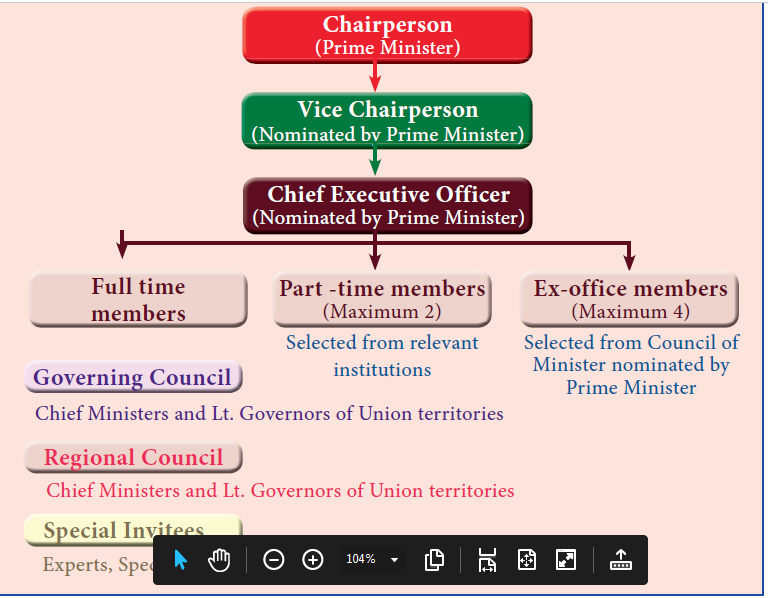
The composition of NITI Aayog is diverse and designed to bring together expertise from various fields to contribute to India’s transformation. Here’s a breakdown:
Governing Council:
- Chairperson: The Prime Minister of India
- Members:
- Chief Ministers of all states and Union Territories with legislatures
- Lt. Governors of other Union Territories
- Up to four Ex-Officio members from the Union Council of Ministers, nominated by the Prime Minister (currently Amit Shah, Rajnath Singh, Nirmala Sitaraman, and Narendra Singh Tomar)
- Vice Chairman of NITI Aayog (currently Suman Bery)
- Full-Time Members of NITI Aayog (varying number of experts appointed by the Prime Minister)
- Special Invitees (Ministers relevant to specific initiatives) – currently Nitin Gadkari, Piyush Goyal, Virendra Kumar, Ashwini Vaishnaw, and Rao Inderjit Singh
Secretariat:
- Chief Executive Officer: Heads the day-to-day operations and leads a team of specialists in various areas
- Additional Secretaries/Senior Advisers/Senior Leads: Support the CEO and manage specific verticals within NITI Aayog
This structure ensures that NITI Aayog has:
- Political leadership: The Prime Minister and Chief Ministers guide the overall direction.
- Technical expertise: Full-time members and specialists provide in-depth knowledge on various subjects.
- State and Union Territory representation: Chief Ministers and Lt. Governors bring perspectives and concerns from different regions.
- Flexibility: Special Invitees can be brought in for specific projects or areas requiring focused attention.
This blend of leadership, expertise, and representation allows NITI Aayog to tackle complex challenges and develop comprehensive strategies for India’s development.
Niti aayog objectives
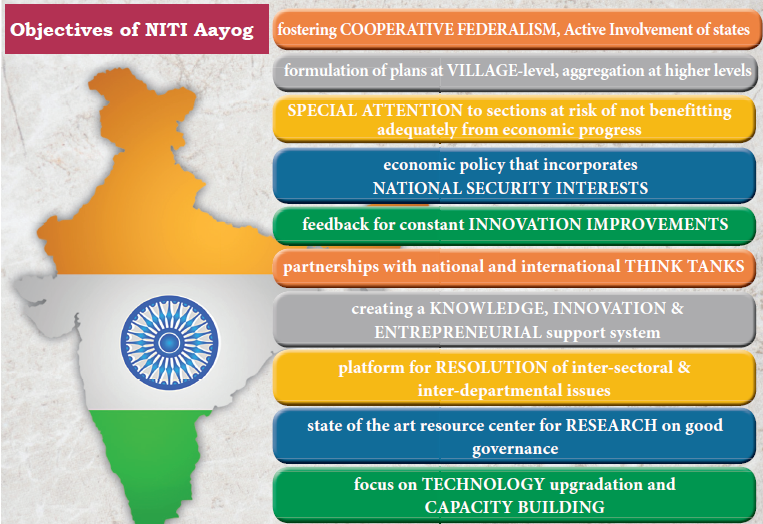
NITI Aayog, the National Institution for Transforming India, has a multifaceted mission aimed at propelling India’s progress. Here are its key objectives:
1. Foster sustainable economic growth:
- Drive economic development with a focus on inclusivity and poverty reduction.
- Catalyze strategic investments in infrastructure, innovation, and human capital.
- Promote efficient and effective use of resources.
- Cultivate a vibrant entrepreneurial ecosystem.
2. Enhance social development and well-being:
- Ensure equitable access to quality education, healthcare, and basic amenities.
- Empower women and marginalized communities.
- Bridge the digital divide and promote digital literacy.
- Foster environmental sustainability and climate resilience.
3. Strengthen federalism and cooperative federalism:
- Promote active participation of states and Union Territories in national development goals.
- Foster collaborative partnerships between centre and states for efficient policy implementation.
- Strengthen center-state relations and address regional concerns effectively.
4. Build a knowledge-driven economy:
- Leverage innovation and technology to address development challenges.
- Foster a culture of research and knowledge dissemination.
- Attract global talent and expertise.
- Promote evidence-based policymaking and data-driven decision-making.
5. Enhance global competitiveness and strategic partnerships:
- Project India’s soft power and cultural influence internationally.
- Forge strategic partnerships with other nations for mutual benefit.
- Attract foreign investments and promote India as a global trade hub.
Additional guiding principles:
- Pro-people: Prioritize the needs and aspirations of all citizens.
- Pro-active: Identify and address challenges before they escalate.
- Participatory: Encourage inclusivity and stakeholder engagement in policymaking.
- Empowering: Enable states and individuals to drive development.
- Inclusive: Ensure everyone benefits from India’s growth story.
- Equitable: Bridge social inequalities and promote fair opportunities for all.
- Transparent: Maintain open communication and accountability in all processes.
These objectives and principles underpin NITI Aayog’s efforts to transform India into a prosperous, equitable, and sustainable nation.
Functions of Niti Aayog
NITI Aayog’s functions are multifaceted and designed to tackle India’s complex development challenges. Here’s a breakdown of its key roles:
1. Strategic policy formulation:
- Develop and propose long-term and integrated national development strategies.
- Conduct in-depth research and analysis on critical issues like climate change, poverty, and education.
- Draft and review national policies across various sectors like agriculture, infrastructure, and healthcare.
- Monitor and evaluate the effectiveness of implemented policies.
2. Cooperative federalism:
- Foster collaboration and partnerships between the central government and states/UTs.
- Support states in formulating their development visions and strategies.
- Facilitate knowledge sharing and best practices among states.
- Resolve inter-state issues and disputes amicably.
3. Knowledge management and innovation:
- Serve as a national think tank, attracting and retaining top talent and expertise.
- Conduct cutting-edge research and analysis on emerging challenges and opportunities.
- Disseminate knowledge and policy recommendations through reports, publications, and conferences.
- Foster innovation and incubation of new ideas for development solutions.
4. Monitoring and evaluation:
- Establish a robust monitoring framework for tracking progress towards national goals and SDGs.
- Collect, analyze, and interpret data to assess the impact of policies and programs.
- Identify bottlenecks and suggest course corrections for improved efficiency and effectiveness.
- Strengthen data-driven decision-making across government agencies.
5. International collaboration and partnerships:
- Represent India in international forums and collaborate with other nations on global issues.
- Build strategic partnerships with international organizations and development agencies.
- Attract foreign investments and expertise to support India’s development goals.
- Showcase India’s best practices and learn from global experiences.
Additional functions:
- Act as a nodal agency for SDGs implementation in India.
- Manage several flagship programs like the Aspirational Districts Programme and Atal Mission for Rejuvenation and Urban Transformation.
- Provide secretarial support to the Governing Council and its committees.
These functions demonstrate NITI Aayog’s proactive and collaborative approach to national development. It strives to be a catalyst for positive change, guiding India towards a sustainable and equitable future.
Conclusion
NITI Aayog represents a transformative shift in India’s approach to economic planning and development. As the successor to the Planning Commission, NITI Aayog embraces a more inclusive, bottom-up philosophy, encouraging the active participation of states and a diverse range of stakeholders. Its emphasis on cooperative federalism, flexibility in planning, and fostering innovation reflects a dynamic response to the evolving needs of a rapidly changing global landscape. By fostering a collaborative and adaptive framework,
Niti Aayog in News
2025
- GAME (Global Alliance for Mass Entrepreneurship) and NITI Aayog have formed a strategic partnership to strengthen entrepreneurship ecosystems across India. The collaboration aims to empower local entrepreneurs by engaging government, corporates, educational and financial institutions, and community organisations.
- The Atal Innovation Mission (AIM) hosted Mega Tinkering Day, bringing together students from all 35 States and Union Territories. AIM is a flagship initiative launched by NITI Aayog in 2016 to promote innovation and entrepreneurship across India.
- The ‘WE RISE’ (Women Entrepreneurs Reimagining Inclusive and Sustainable Enterprises) initiative was launched recently to strengthen women-led enterprises. “We raise” is a joint public-private partnership launched by NITI Aayog’s Women Entrepreneurship Platform (WEP) and DP World. It aims to empower high-potential women-led Micro, Small, and Medium Enterprises (MSMEs) by supporting them to become export-ready and scale their businesses in global markets.
- CARBON CAPTURE USAGE STORAGE (CCUS) TECHNOLOGY – India has launched multiple initiatives to reach net-zero emissions by 2070, including a strong focus on developing and deploying Carbon Capture, Utilisation, and Storage (CCUS) technology. NITI Aayog released a “CCUS Policy Framework and Deployment Mechanism in India” report in 2022, which sparked discussions and outlined a roadmap for CCUS adoption. It proposes policy initiatives like viability gap funding, carbon pricing mechanisms, carbon trading, and production-linked incentives (PLI) to encourage commercial-scale deployment.
- NITI Aayog has launched AI for Viksit Bharat Roadmap and the NITI Frontier Tech Repository under its Frontier Tech Hub.
- The NITI Aayog, in collaboration with the Ministry of Development of North Eastern Region (MoDoNER) and with support from the United Nations Development Programme (UNDP), has released the second edition of the North Eastern Region (NER) District SDG Index 2023–24. The NER District SDG Index measures the progress of Sustainable Development Goals (SDGs) across districts in India’s eight North Eastern States.
- The Union Cabinet has approved the Prime Minister Dhan-Dhaanya Krishi Yojana (PMDDKY) to benefit 1.7 crore farmers across India. PMDDKY is an initiative to transform agriculture in 100 underperforming districts, with a special focus on improving agricultural productivity, sustainability, and farmer incomes. NITI Aayog will guide implementation, provide capacity-building support, and oversee monitoring.
