Natural vs Artificial Magnets
| Natural Magnets | Artificial Magnets |
| They are used in day-to-day applications. | The strength of the magnet is natural,l and it is difficult to change. |
| These are made by man, which is a definite shape based on the usage. | They are used in day-to-day applications. |
| Natural Magnets are long-lasting, i.e that does not lose their magnetic power. | It loses magnetic strength with time |
| They have less usage | They are usage day to day applications. |
Magnetism Tnpsc
This note is written for the Tnpsc for the topic “Magnetism”, in the general studies.
This note is prepared from the Tamil Nadu, Samacheer Kalvi Books.
Natural magnet and Artificial magnet
Magnets are materials such as stone, tools,s or metal that have the property of attracting metals such as Nickel, Iron, or cobalt. This attractive property of materials is called Magnetism.
Magnetism is of two types: Induced or Natural.
The branch of physics that studies the properties of a magnet is also called Magnetism. The usage of the earliest Magnet was found in Asia Minor, called Magnesia.
It is believed the Chinese knew about the Magnets as early as 200 BC. The Chinese also used a magnetic compass for navigation in 1200 A.D.
Today, magnets are used everywhere, from electricity production to engines, elevators, speakers, etc.
Magnetised Materials
Classification of Magnets
There are two kinds of Magnets: Natural magnets and Artificial magnets.
Natural Magnets
The magnets that are found naturally are termed natural magnets. Natural magnets are Permanent Magnets, which means they do not lose their magnetic power.
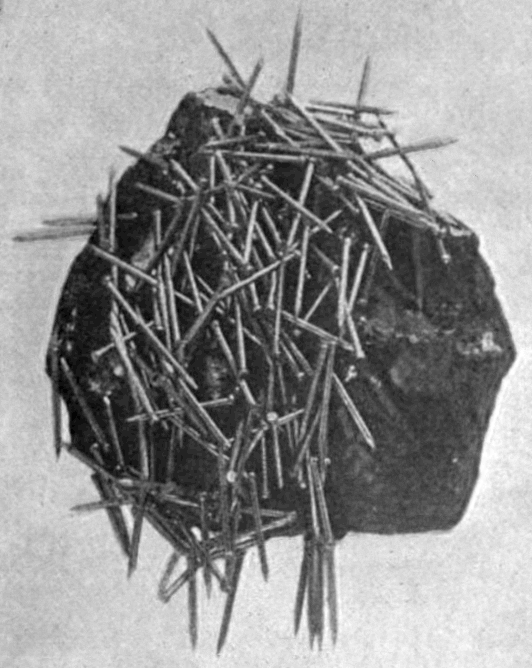
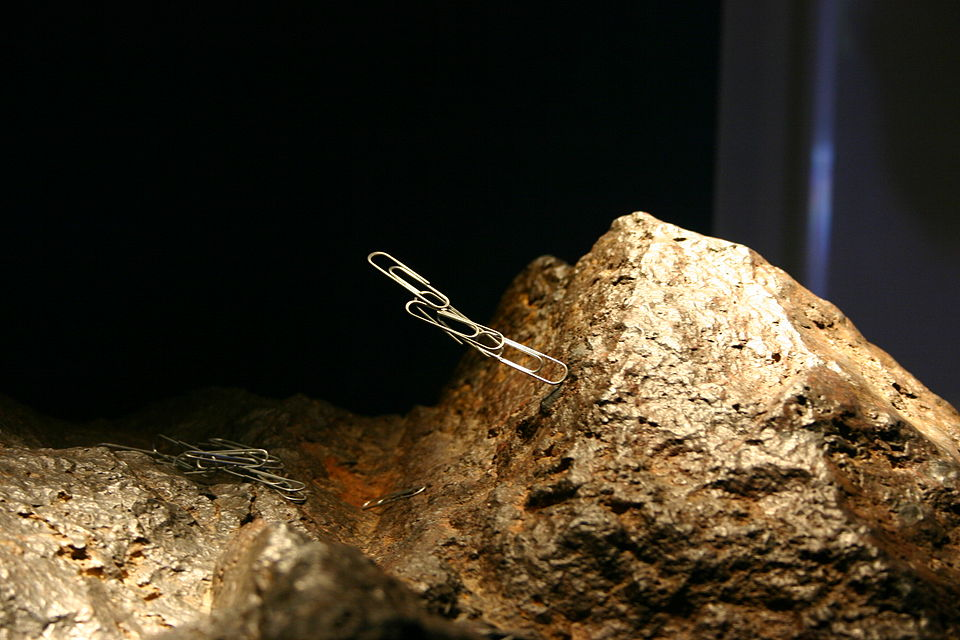
Natural Magnets are found in different places, such as sandy deposits. The strongest natural magnet is Lodestone, called Magnetite or Iron oxide, which is the ore of iron.
Some other natural magnets are Minerals such as Pyrrhotite or Iron Sulphide, Ferrite, and Columbite. There are three types of Iron ores: hematite (69% of Iron), Magnetite (72.4% of Iron), and Siderite (48.2% of Iron).
Among the Iron ores, Magnetite (Fe2O4)has the strongest Magnetic property.
Artificial Magnets
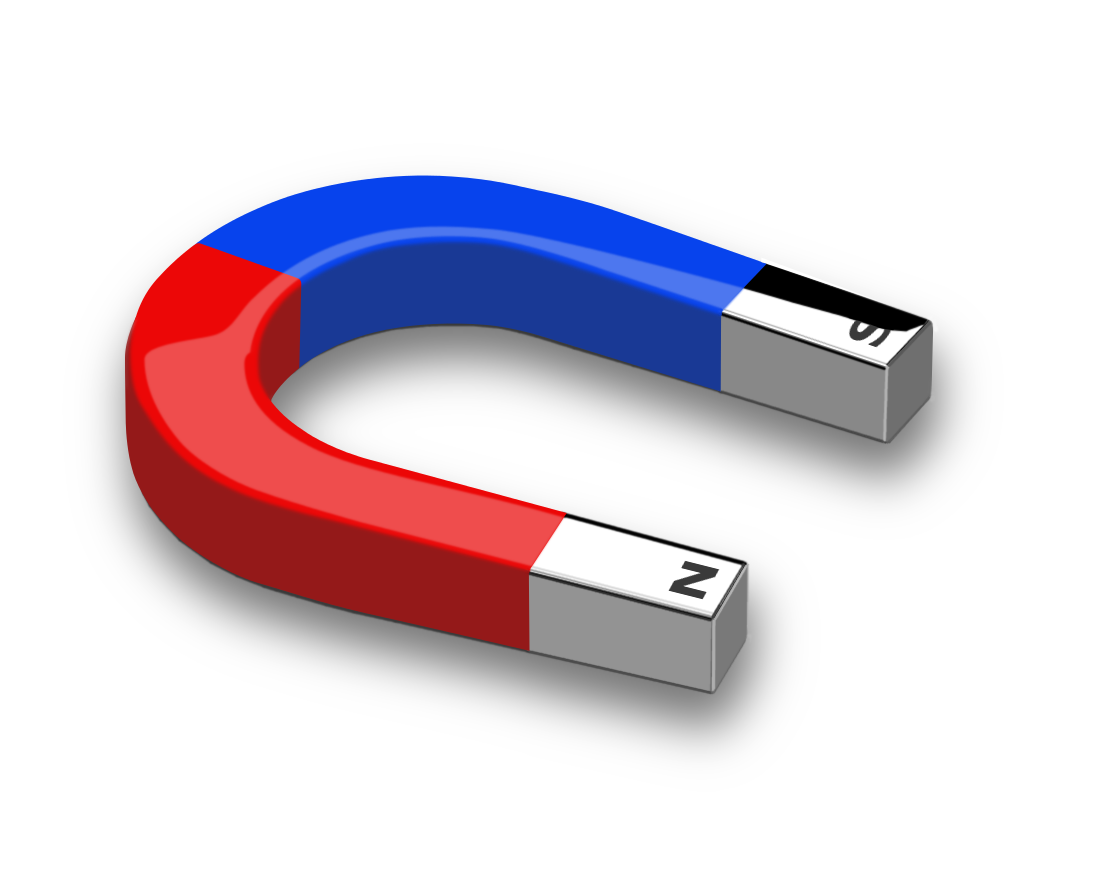
Magnets that are man-made in labs or companies are called Artificial Magnets or Man-Made Magnets. Artificial magnets normally have stronger magnetic fields than Natural Magnets. There are various shapes, and artificial magnet examples are made, such as bar magnets, U-Shaped Magnets, Horsehoe Magnets, Cylindrical Magnets, disc magnets, ring magnets, and electromagnets.
The artificial magnets are made of Nickel, cobalt, steel, iron, etc, and made of alloys such as Neodynium and Samarium.
Magnetic Field
The magnetic field is defined as the space around a magnet in which its magnetic effect or influence is noticed, and it is measured in units of tesla or gauss ( 1 tesla = 10,000 gausses).
Tracing the magnetic field
A compass needle, also known as a plotting compass or magnetic needle consist of a tiny pivoted magnet in the form of a pointer that rotates freely in the horizontal plane.
The ends of the compass approximately point towards the North-South Direction.
Magnetic Materials
Materials that are attracted to Magnetic forces are called Magnetic materials, and materials that are not attracted toward Magnetic forces are called non-magnetic materials.
Magnetic materials can be magnetised to form Permanent magnets. Magnetic materials are of two types: magnetically soft materials and magnetically hard materials. Magnetically hard materials require a strong magnetic field to get magnetised.
It is because the different atomic structures behave differently when placed in a magnetic field.
Classification of magnetic materials
Materials are classified based on their behaviour in the magnetic fields, such as:
- Diamagnetic
- Paramagnetic
- Ferromagnetic
Classification of Magnetic materials: Natural magnet and Artificial magnet
Diamagnetic Materials
The Diamagnetic materials have the following characteristics:
Diamagnetic materials, when suspended in an external uniform magnetic field, will align perpendicular to the direction of the magnetic field.
Diamagnetic have a tendency to move away from the stronger part to the weaker part when it’s suspended in a non-uniform magnetic field. Diamagnetic materials get magnetised in the direction opposite to the magnetic field.
Examples: Bismuth, Copper, Mercury, Gold, Water, Alcohol, Air, and Hydrogen. The magnetic character of the Diamagnetic materials does not get affected by the external temperature.
Paramagnetic Materials
Paramagnetic materials have the following characteristics:
When a Paramagnetic Material is placed freely suspended in a uniform magnetic field, it will align itself parallel to the magnetic field. They have the tendency to move from the weaker part to the stronger part when placed in a non-uniform magnetic field.
Paramagnetic materials get magnetised in the direction of the field.
Example: Aluminium, Platinum, Chromium, oxygen, manganese, solutions of salts of nickel and iron. The magnetic character of Paramagnetic materials gets affected by external temperature.
Ferromagnetic Materials
When a suspended Ferromagnetic Material is placed in a uniform magnetic field, it will align itself in parallel to the direction of the magnetic field.
When a suspended Ferromagnetic Material is placed in a non-uniform magnetic field, it will move quickly towards the stronger part from the weaker part.
Ferromagnetic Material strongly gets magnetised in the direction of the field. Examples: Iron, Cobalt, Nickel, Steel, and its alloys.
The magnetic character gets affected by the external temperature. Ferromagnetic Material, when heated, becomes Paramagnetic Material.
The temperature at which Ferromagnetic materials become paramagnetic materials is called the Curie Temperature. (2)
Artificial Magnets
These are man-made magnets, made from magnetic materials. These are commonly made by magnetising iron or steel alloys electrically.
“Artificial magnets are made by stroking a magnetic material with magnetite or with other artificial magnets”. (Wikipedia) (Tamil Nadu Government #)
These kinds of processes are called Magnetisation.
“The magnetisation is a process in which an object is turned into a permanent or temporary magnet by exposing it to an external maternal magnetic field”.
Depending upon their magnetic power retaining nature, the artificial magnets are classified into two types: one temporary and another one is a permanent magnet.
Temporary Magnets
Temporary Magnets are made by an external magnetic field. Temporary Magnets lose their magnetic property as soon as the external magnetic field is removed.
Temporary Magnets are made from soft iron. Soft iron acts as a magnet by the influence of an external magnetic field produced in a coil of wire carrying electricity.
Soft iron loses its magnetic property as soon as the electricity is stopped.
Examples: Magnets used in a crane, an electric bell.
Permanent Magnets
Permanent Magnets are artificial magnets that retain their magnetic property even after the external magnetic field is removed. The Permanent magnets are made from hardened steel and alloys of some metals.
Generally, the alloy used to make permanent magnets is ALNICO (An alloy of aluminium, nickel, and cobalt).
Examples of Permanent Magnet usage are a refrigerator, a bar magnet, a speaker magnet, a fridge, a magnetic compass, etc.
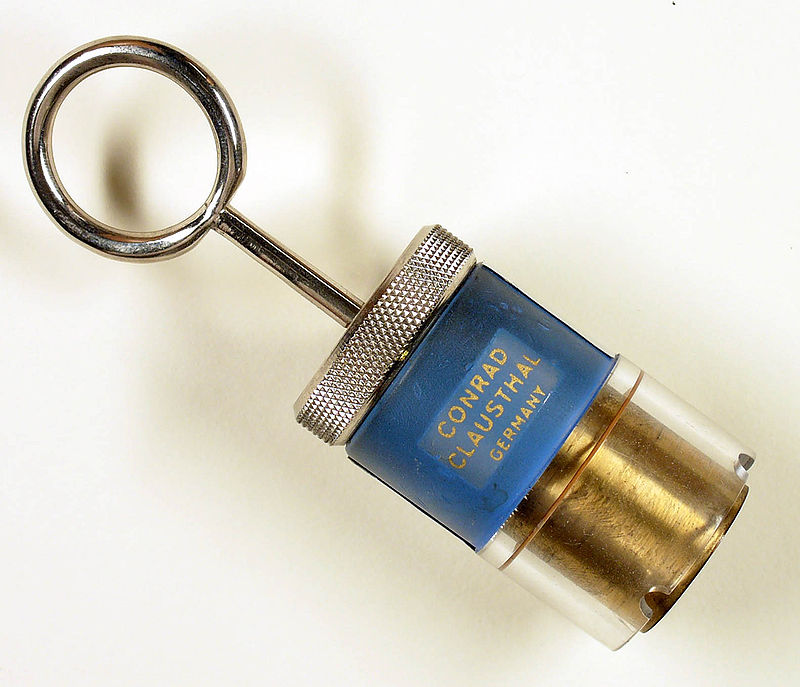
Neodymium magnets are the strongest magnets on Earth. Alnico cow magnets are used to attract sharp iron objects such as wire, nails, and are ingested by animals grazing, which also damages their digestive tract.
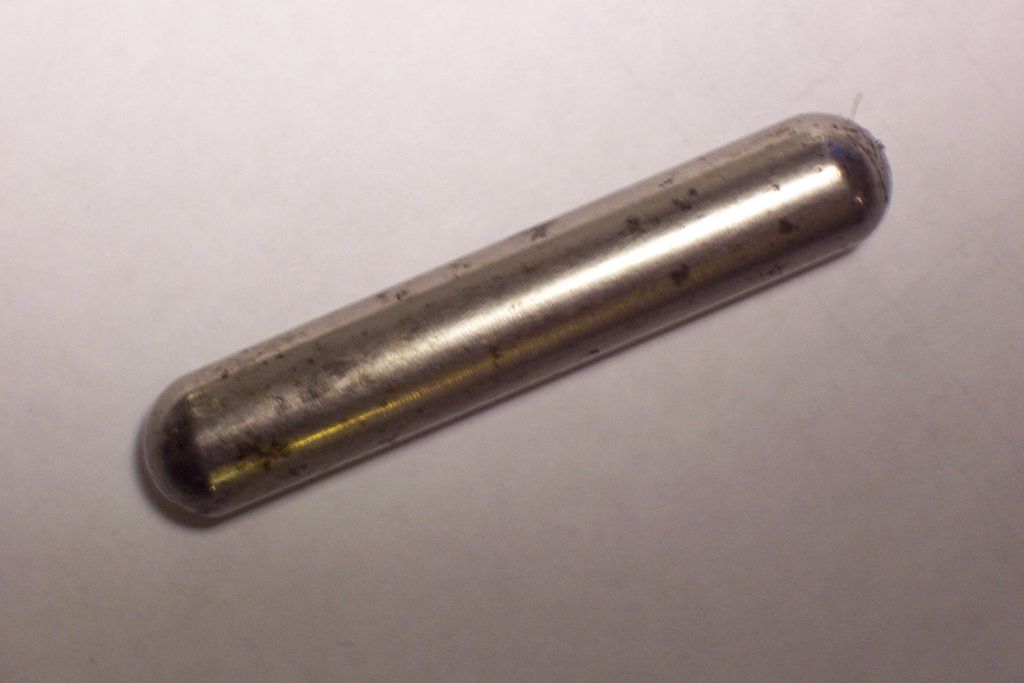
Cow magnets facts
It is used by farmers to prevent Hardware disease called Bovine Traumatic Reticuloperitonitis, as Cow might swallow nails, wire etc. This magnet of the size of the finger is placed inside a bolus gun and it is essentially a long tube that ensures the magnet goes down the cow’s throat. This magnet settles inside the reticulum collecting any pieces of metals.
The Magnetic properties are lost in the following ways:
Leaving the magnet unused for a long time. The endless hammering of the magnetic material. Releasing a magnet from a height. Roasting magnet to great temperature. Giving a variable current in a coil that encircles the magnet. Incorrect storage of the magnet.
Uses of Magnet
In ancient days, magnets were used as a ‘Direction Stone’, used for Navigation. Used to dynamos, to generate electricity. Electromagnets are used in electric bells, etc. Used in Motors. Used in speakers, microphones, etc
The powerful electromagnet used in Maglev trains. In industries, magnetic conveyor belts are used to sort magnetic substances from scraps. Used in computers as storage devices, such as hard disks.
Used in Atm card, Magnetic strips are made of tiny iron-based magnetic particles in a thin plastic film. MICR number printed on the cheque in Banks. Tip the screwdriver with a magnet to attract the screw.
MRI (Magnetic Resonance Imaging) is used to scan the internal organs in hospitals.
Other Facts on Magnetism
Pigeons have magnetite in their beak, which helps in navigation by sensing the magnetic field of the earth, a sense is called magneto-reception.
The most powerful magnet in the universe is a Neutron Star called Magnetar (Magnetic Neutron star) in the Milky Way, with a diameter of 20km and a mass of 2 to 3 times that of the Sun.
FAQ
How is an artificial magnet prepared from a natural magnet?
The method for making artificial magnets is known as simple touching. Simple touching is performed by rubbing the entire length of the steel bar with the end of a magnet loadstone only in one direction.
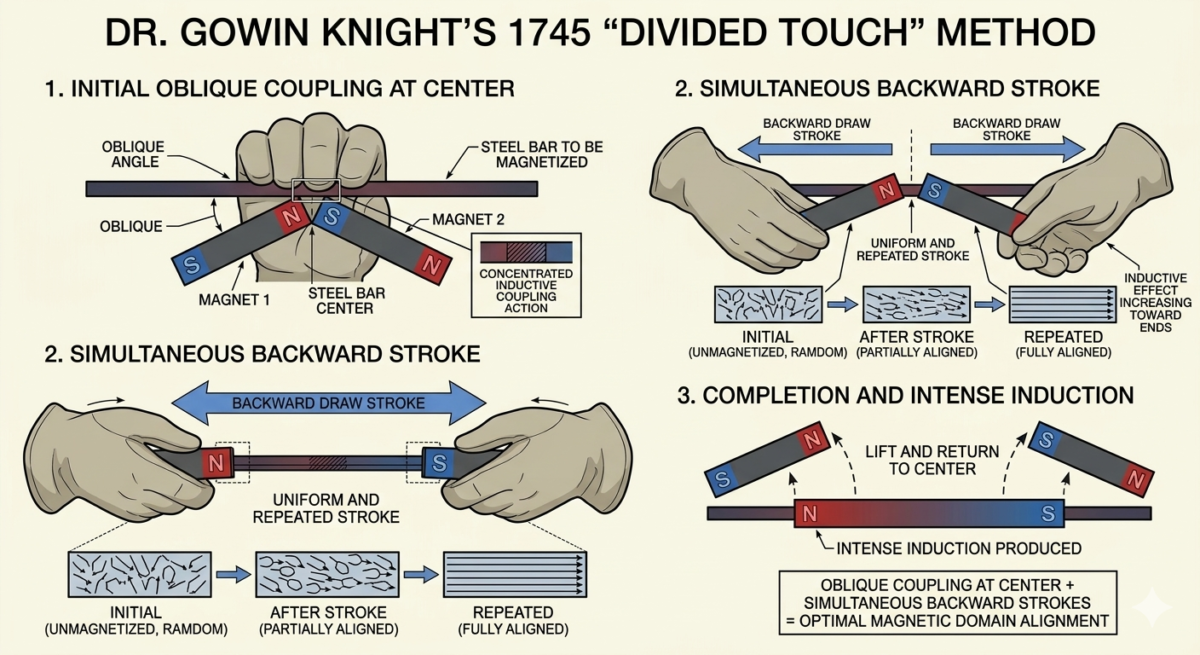
In 1745, Dr.Knight invented a method by which two bar magnets are held obliquely and placed with their opposite poles close together, upon the middle of the steel bar. Both magnets are then drawn backwards upon a bar, and this method is repeated. This method has provided more intense inductive effects produced by the coupling action between the opposite poles of the magnets.
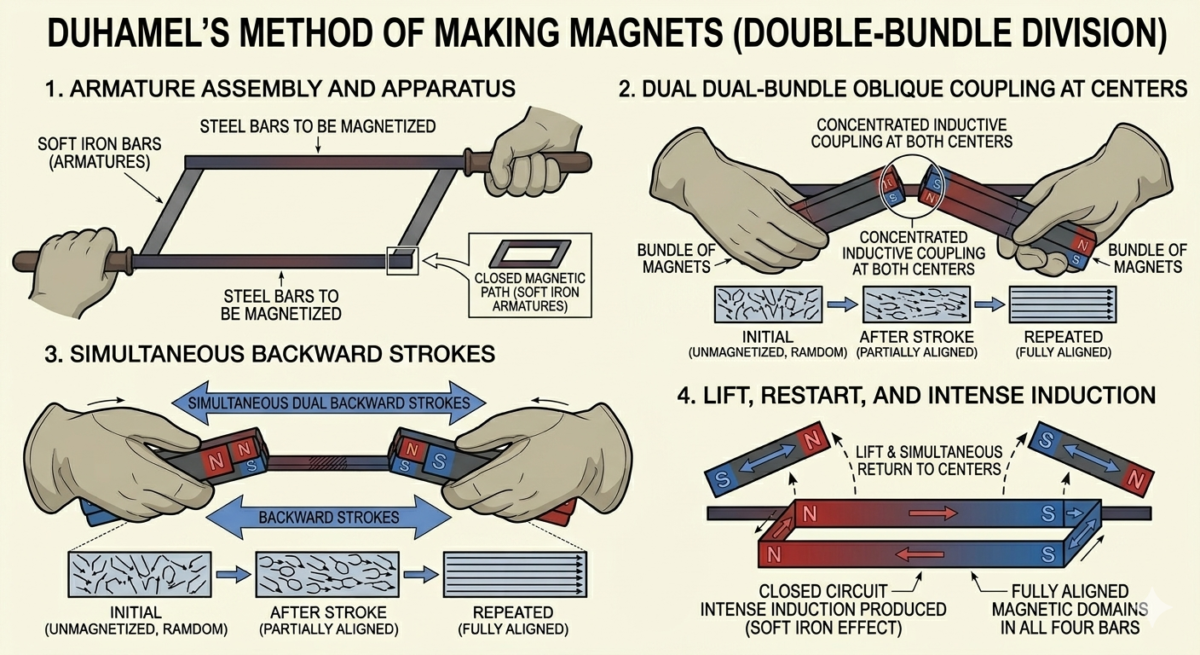
Duhamel Method of Making Magnets
A parallelogram is formed of two steel bars connected by two short bars of soft iron, and each of the steel bars is then rubbed in the same manner with two bundles of magnets instead of single magnets, as in the case of the Knights’ method.
This method gave better results than the Knights method due to the reaction of the induced magnetism of the soft iron bars or armatures and the greater power of a number of magnets when combined.
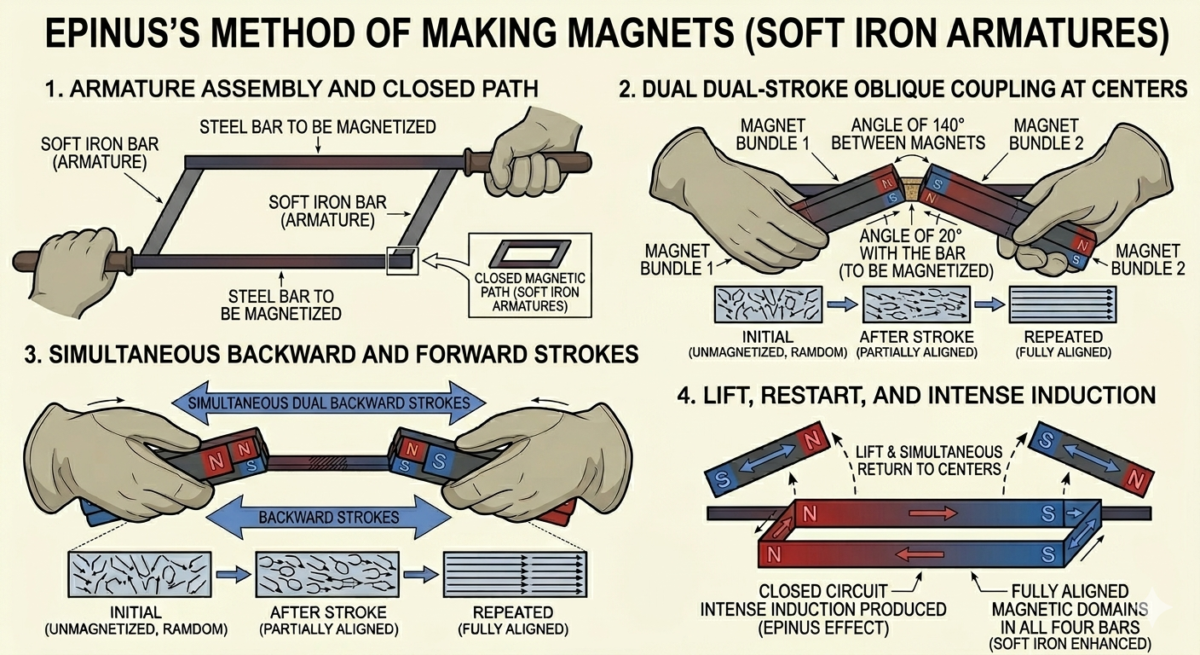
Epinus Method
In this method the bars are arranged in the method of Duhamel. But in this case the steel magnets are substituted by soft iron armatures, which form the ends of the parallelogram. Each of the bars is then rubbed backwards and forwards with the opposite poles of two magnets separated by a small piece of cork, and inclined so as to form an angle of 140° with each other and angles of 20° with the bar to be magnetized.
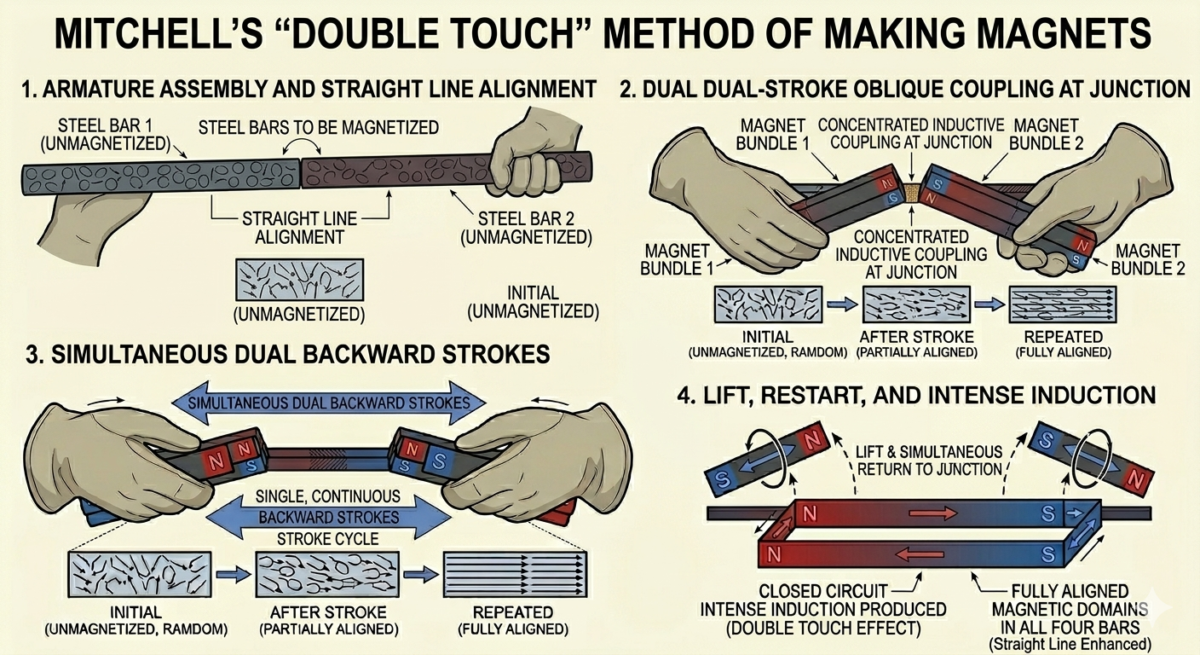
Double Touch
This method was invented by Mitchell, where the steel bars to be magnetized are place end to end in a straight line and then rubbed with a horse shoe magnet or with the opposite poles of two powerful bar-magnets, slightly separated from each other. In this process care must be taken not to reverse the direction of the magnetizing forces by changing the relative position and motion of the poles of the horse shoe magnet.
Bibliography
- Tamil Nadu Government. 8th Science Book. First Edition ed., vol. III, Chennai, Tamil Nadu Text Book Corporation, 2019. 3 vols. Samacheer Kalvi, http://tnschools.gov.in/media/textbooks/8th_Science_EM_Combined_05-03-2020.pdf. Accessed 27 10 2020.
- Britannica, and Gloria Lotha. “Curie point.” Britannica, Encyclopædia Britannica, Inc, 20 July 1998, https://www.britannica.com/science/Curie-point. Accessed 28 10 2011.