
The Imperial Guptas, the founder of this dynasty, Srigupta c, 260 AD and his son Ghatotkaca. The coins start in the reign of the third member of the dynasty, Chandragupta I, who was the first to use the imperial title maharajadhiraja, who was known as the actual founder of the Gupta era, the first year of which is 319-20 AD.
The Gupta era, the period of Gupta supremacy in Northern India, starts with 319-20 AD and ends with the death of Skandagupta in 480 AD.
After the death of Skandagupta, the Hunas attacks started, and probably also internal conflicts led to divisions of the Empire. The later Gupta period comes to an end in 606 AD, when Harsavardha of Kannuj gained supreme power over the whole of Northern India.
Sources of the Guptas and the Rise of the Gupta Empire
The rise of the Guptas is provided by the literary work Devichandraguptam and the Mudhrakshasam written by Visakadatta. Chinese traveller Fahien visited during Chandragupta II and wrote about the social, economic, and religious conditions of the Gupta Empire.
The achievement of Chandragupta I is found in the inscriptions from the Mehrauli Iron Pillar Inscription and the Allahabad Pillar Inscription.

The personality and achievements are written in classical Sanskrit using Nagari script, which consists of 33 lines composed by Harisena on the Asokan Pillar. The Asokan pillar inscription says about Samudragupta’s accession and relationship with the ruler, Samudragupta as a poet and scholar, and his military campaigns in North India and the Deccan.
Gupta era coins contain legends and figures, thus providing details about titles and sacrifices.
Iron Pillar of the Gupta Period
It is made of 98% wrought iron, and it is considered an achievement in metallurgy as it has not been destroyed due to rusting and still stands strong for more than 1600 years.
This pillar was erected during Chandragupta II for the God Vishnu in the 4th century AD. Its height is 7.2 meters, its diameter is 40.64 cm, and its weight is over 6 tonnes. It is located in the Qutb complex at Mehrauli in Delhi, and it has inscriptions of the time of Gupta rule.
Chandragupta I (320-330 A.D)
“Sri Gupta” is the founder of the Gupta Dynasty and was succeeded by Ghatotkacha, and these two were called Maharajas. The next ruler was Chandragupta I, and he was called Maharajadhiraja (The great king of Kings) due to his extensive conquests.
He married Kumaradevi, Princess of Licchavis, and strengthened his position. Mehrauli Iron Pillar inscriptions are important as they mention the details of his conquest. Chandragupta is considered the founder real founder of the Gupta dynasty due to the extensive conquest that started in 320 AD.
The original capital of the Gupta empire seems to be Pataliputra, and the inscription Licchavayah, which occurs on Gold coins together with the name of his queen Kumaradevi, may denote that she belonged to the royal family of Licchavis.
Samudragupta(330-380 AD)
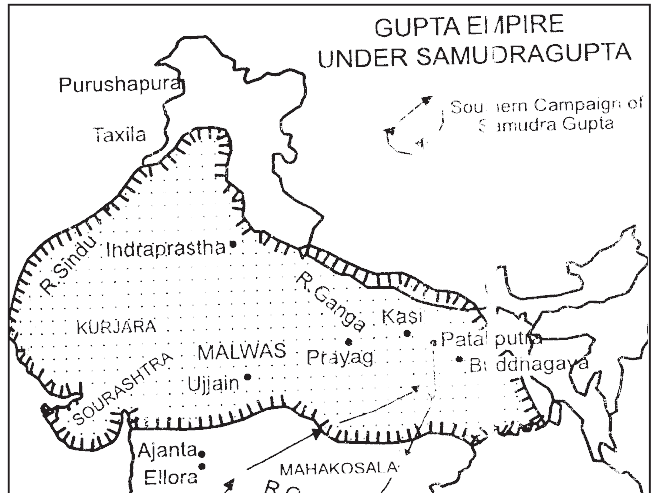
The greatest ruler of the Gupta Dynasty. The Allahabad pillar inscription of samudragupta provides his detailed account. His military conquest was divided into three stages, as mentioned in the Allahabad inscription.
The first one is against some rulers of North India, the second one is his Dakshinapatha expedition, which is against southern rulers, and the third one is against other rulers of North India. First Campaign of Samudragupta – Samudragupta defeated Achyuta and Nagasena. Achyut, a Naga ruler and Nagasena, ruled the upper Gangetic valley and belonged to the Kota family.
The policy of Samudragupta for the south is different; he insisted on authority in the south and did not annex it into his kingdom. The Third Campaign- His third campaign was to eliminate the remaining north India rivals. He annexed 9 kingdoms of the North; most of these kings were of the Naga family.
After victories, Samudragupta performed the Ashwamedha sacrifice and issued gold and silver coins with the legend ‘restorer of the Ashwamedha. Samudragupta is also called the Indian Napoleon. The extent of Samudragupta’s Empire:
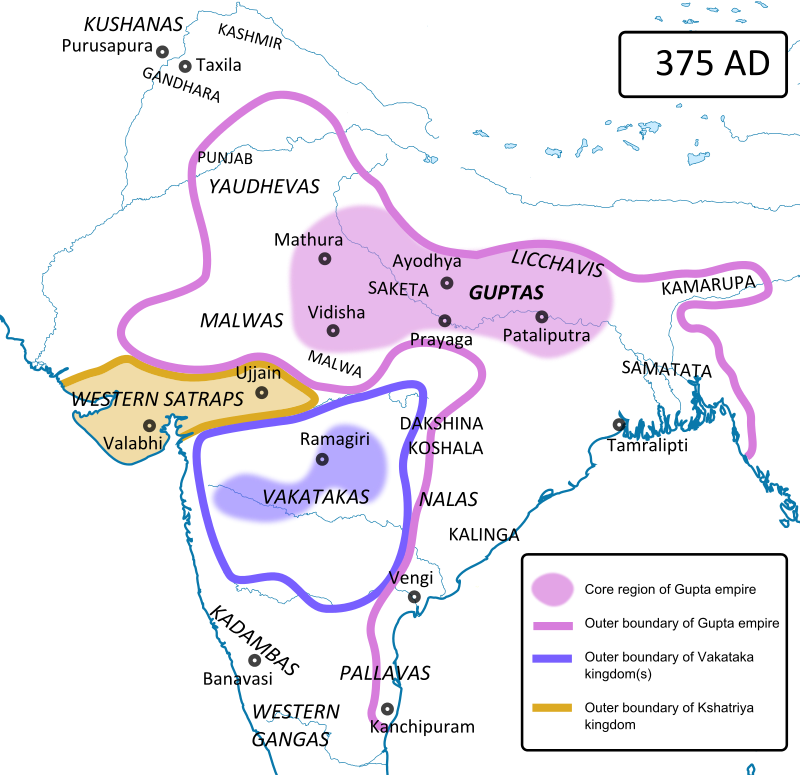
Upper Gangetic Valley, the modern Uttar Pradesh, part of central India, and the Southwest part of Bengal were directly under the administration of Samudragupta.
Saka and Kushana of the west and northwest were under the influence of Samudragupta. The Pallava kingdom, the east coast of the Deccan, was under Suzerainty.
Estimate of Samudragupta
Samudragupta’s military achievements and his accomplishments were described in the Allahabad inscriptions. Called “Kaviraja” for his ability in composing, intellect, poetry, and skill in music.
Coins depicting Samudragupta with a veena were issued. Harisena was a famous poet and scholar during Samudragupta’s period and also a patriot of many scholars and poets.
Followed Vaishnavism and was tolerant of other religions, and also a patron of Buddhist scholar Vasubandhu.
Chandragupta II(380-415 A.D)
Son of Samudragupta. According to some scholars, Ramagupta, the elder brother of Chandragupta II, was the immediate successor to the throne.
- Chandragupta II was a military genius and extended the Gupta empire through the combination of warfare and diplomacy.
- Chandragupta II married Kubernaga, a Naga princess of central India, and gave his daughter Prabhavati to Rudrasena II, prince of Vakataka.
- Vakataka had a strategic position in the Deccan. Through the matrimonial alliance with Vakataka, Chandragupta II had the conquest of Western India against the Sakas.
Achievement of Chandragupta 2
Rudrasimha III, the last ruler of the Sakas satrap of Western India, was killed by Chandragupta II and his territories in western Malwa and Kathiawar were annexed.
- After the victory, Chandragupta II performed a horse sacrifice and assumed the title Sakari( Destroyer of Sakas). Chandragupta II called himself “Vikramaditya”.
- The western boundary got extended up to the Arabian Sea, Broach, Sopara, Cambay, and other seaports got under its belt. The empire controlled trade with Western countries.
- Ujjain became an important city and an alternative capital. Fine cotton clothes of Bengal, scents of the Himalayas, Indigo from Bihar, spices, and sandals from the south were traded in return for Roman Gold from these ports.
The Gupta empire issued a variety of gold coins. Chandragupta II defeated the chiefs in Vanga, crossed the river Sindh and conquered Bactria; the Kushanas were subdued.
- The territories reached western Malwa, Gujarat and Kathiawar, and the Hindukush up to Bactria in the northwest. Even eastern Bengal and south of the Narmada River were boundaries.
- Contributed to cultural progress and patronised great scholars such as Kalidasa. His age is considered a Golden age in cultural progress. Chinese traveller and pilgrim, Fahien visited during the Chandragupta II period.
Fa Hien Gupta Empire: Chinese traveller Fa Hien visited India during the reign of Chandragupta II
Fa Hien visited during the Chandragupta II period. Stayed 9 years in India, and spent 6 years in the Guptas empire.
- Through Khotan, Kashgar, Gandhara, and Punjab, India was reached by land route. The other places visited are Bodh Gaya, Kasi, Peshawar, Mathura, Kanauj, Sravasti, Kusinagara, Pataliputra, and Kapilavastu.
- Returned via sea route after visiting Ceylon and Java. The purpose of the visit was to collect Buddhist manuscripts and to see the land of Buddha.
- He stayed in Pataliputra for three years to study Sanskrit and copy Buddhist preaching for his texts. Fa Hien provided valuable information on the social, religious, and economic conditions of the Gupta empire.
According to Fa Hien, Buddhism was great in North-Western India, and the Gangetic Plain was the “Land of Brahmanism”. Mentions holy places such as Kapilavastu and Kusinagara were in an unsatisfactory state for Buddhism.
- According to Fa Hien, the Gupta empire’s economy was satisfactory. Fa Hien characterises Gupta’s administration as mild and benevolent.
- No state interference in the public’s life, and people enjoyed freedom and no restriction on their movement. No severe punishments, only fines were imposed, and there was no spy system.
- The state was generally prosperous, and crimes were negligible. Fa Hien also appreciated the administration, as the roads were generally safe for travellers and the administration was better than that of the Mauryas.
Fall of the Gupta Empire
Kumaragupta was the son of Chandragupta II, who was his successor. His government was generally marked by peace and prosperity. He also performed the Asvamedha sacrifice and issued many coins.
- Kumaragupta laid the foundation of Nalanda University. At the end of his reign, “Pushyamitras“, a wealthy trib,e defeated Gupta’s army.
- Huns from central Asia crossed the Hindukush mountains to invade India. Skandagupta fought successfully and saved the empire from the Huns. This war led to a lot of wastage of the empire’s resources.
- Skandagupta’s death, his successors Purugupta, Narasimhagupta, Buddhagupta, and Baladitya were defeated by the Huns and were unable to save the empire from the Huns. The empire completely fell due to the Huns’ invasion and by Yasodharman in Malwa.
Administration of the Gupta Empire
Gupta kings assumed titles such as Samrat, Chakravartin, Parameswara, Paramabhattaraka, and Maharajadhiraja.
- The kings were assisted by the chief minister, Senapati (Army chief or commander), and other officials. Sandivigraha, a high official, is probably the minister of foreign affairs.
- Maintained provincial administration through officials called Kumaramatya and Ayuktas. Provinces were known as Bhukti,s and provincial governors were called Uparikas.
- The Uparikas were chosen among the princesses. Bhuktis were divided into Vishyas or districts and governed by Vishyapatis.
- The officers of the city administration were called Nagara Sreshtis. Gramikas control villages in the districts.
Literature during the Gupta Empire period
Sanskrit was patronised during the Gupta period. The Nagari script evolved from the Brahmi script.
Great works of Sanskrit in the written form of epic, lyrics, drama, and prose belonged to the Gupta period. The court of Chandragupta II was filled with Navratnas.
The navratnas of Chandragupta 2 are as follows:
- The foremost Navratna was Kalidasa, who wrote Shakuntala, which is considered one of the hundred best books in the world and also wrote two plays, Malavikagnimitra and Vikramorvasiya. His epics are Raghuvamsa and Kumarasambhava, and his lyrics are Ritusamhara and Meghaduta.
Visakadatta, author of two Sanskrit dramas, Mudrarakshasa and Devichandraguptam. Sudraka was the poet of Mrichchakatika, which is rich in humour and pathos.
Bharavi’s Kritarjuniya is the story of the Siva and Arjun conflict. Kavyadarsa and Dasakumaracharita were written by Dandin.
- Vasavadatta was written by Subhandhu. Vishnusarma composed Panchatantra stories. Amarakosa, a lexicon by Buddish author Amarasimha. Puranas were composed during this period. There were eighteen Puranas, the most important were Bhagavata, Vishnu, Vayu, and Matsya Puranas.
- The present form of Mahabharatha and Ramayana was composed during this period.
Science Development during the Guptas Empire Period
Aryabhatta, a great mathematician and astronomer wrote the book in 499 AD that deals with maths and astronomy, which explains solar and lunar eclipses.
- Aryabhatta was the first to declare earth was spherical and rotates on its axis, this observation was later rejected by Varahamihira and Brahmagupta.
- Varahamihira composed Pancha Siddhantika (Five astronomical systems) and his work Brihadsamhita is a great Sanskrit literature work that deals with weather, astronomy, geography, architecture, animals, marriage, astrology, and omens.
- Varahamihira’s Brihadjataka is considered a standard for astrology.
- Vagbhata, a great physician lived during the Gupta period and was the author of Ashtangasamgraha which is eight branches of medicine. Another great medical scholars such as Susruta, and Charaka lived before the Gupta age.
Gupta Empire Culture, Caste and Women Status during the Guptas Empire Period
Foreign residents made permanent residents. The caste system became rigid. Brahmins occupied the top of society and were given enormous gifts by the rulers and wealthy people.
- The practice of untouchability slowly began to rise. Fahien mentions Chandalas, low caste people separated from society and their conditions were miserable.
- The status of women was miserable and they were prohibited from studying Vedic texts and Puranas. Women were made inferior to men, they started practising during this period.
The practice of Swyamvara was given up and early marriage for girls was done as suggested by Manusmriti. Brahmanism reached supreme status during the Gupta period. Brahmanism has two branches Vaishnavism and Saivism. The Guptas were mostly Vaishnavaites and they period horse sacrifices known as Aswamedha.
Brahmanism’s progress caused the decline of Buddhism and Jainism in the Gangetic Valley. In western and southern India, Buddhism and Jainism flourished. The great Jain council was held at Valabhi and the Jain holy book Swetambras was written.
The above article is taken from the Old Tamil State Board book, which is extremely helpful TNPSC exam. Also can be referred for UPSC and other service commission exams.
Some Extra Facts of the Gupta Empire
The Allahabad pillar inscription was composed by Harisena, court poet and minister of King Samudragupta. These inscriptions were called Prashasti, a Sanskrit word that means “in Praise of”.
Gupta’s empire culture
The Hindu epic’s final touches were during the Gupta period, and the Hindu religion flourished and moved to the rest of the sub-continent during this period.
- The evil Caste system grew during the period of the Guptas. The Guptas patronised Vaishnavism and were also tolerant toward Buddhism and Jainism.
- Gupta patronised Buddhist art. The Shakti cult rose in the period of the Guptas. The sacrifice practice of Vaishnavism or Hinduism was replaced by Bhakti and pooja.
- Tantrism practice also emerged during this period . Chaturanga, meaning four-division, now called the Chess game, also emerged during the Gupta period.
Extent of the Gupta Empire
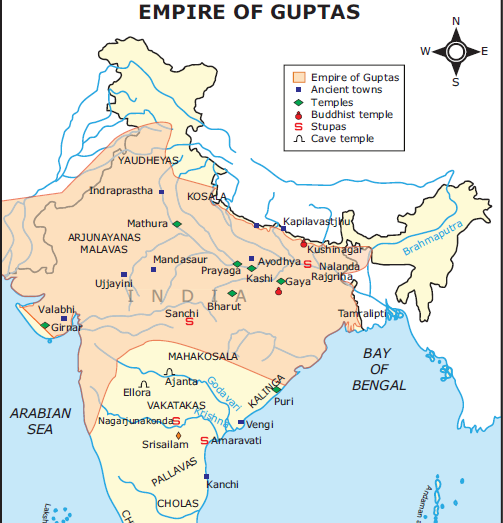
The greatest extent the Gupta empire seems to have comprised the whole of Northern India, with the exception of the Panjab, which continued to be ruled by the Kusanas.
FAQ
Who is the real founder of the Gupta Empire?
Chandra Gupta I
Bibliography
- https://en.wikipedia.org/wiki/Gupta_Empire
- Samacheer Kalvi Book
Downloads
1.Gupta Empire Old Tamil Nadu 11th History Pdf Book
2.Gupta Empire New Tamil Nadu 11th History Pdf Book
